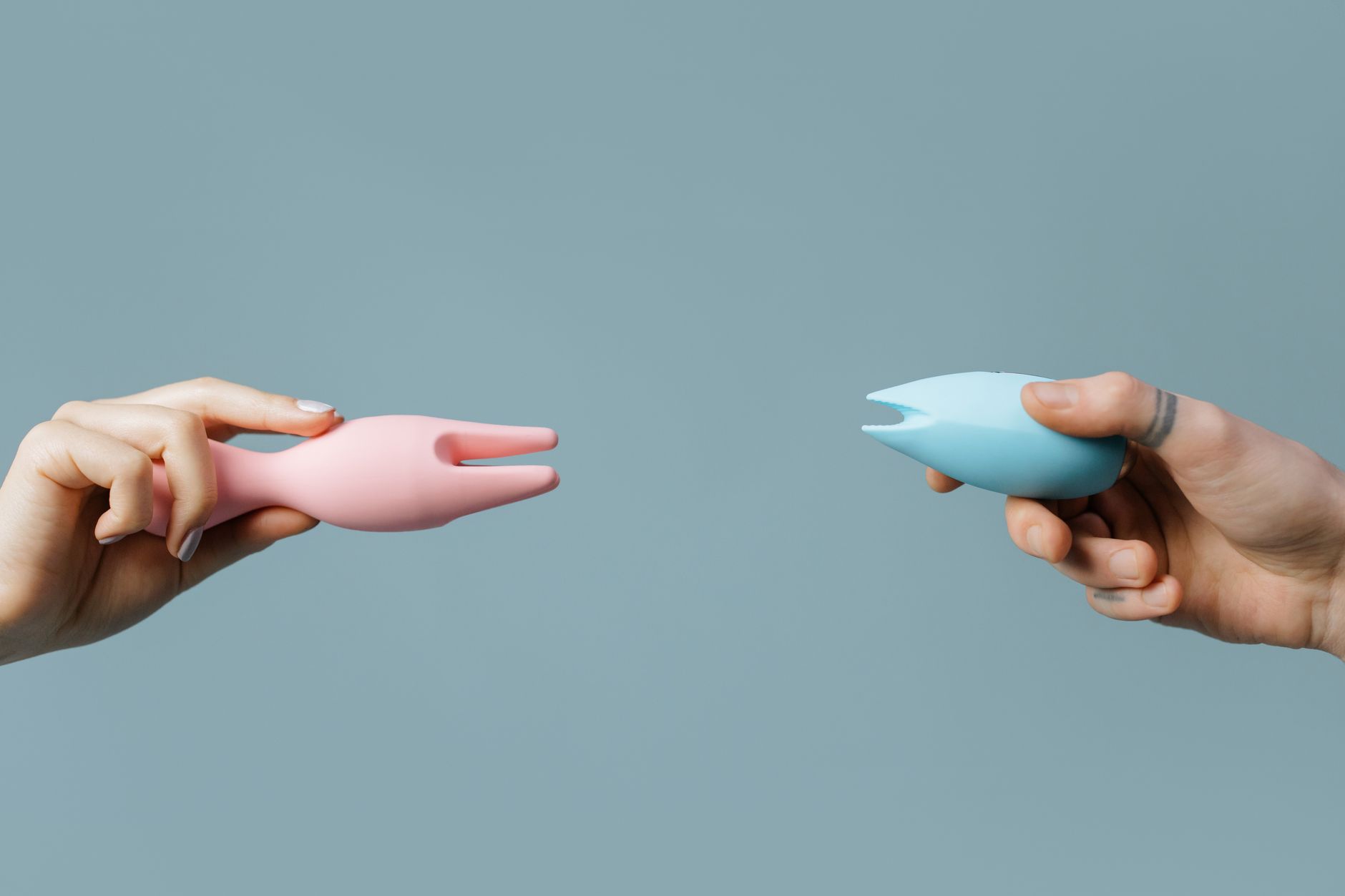
Let's name the awkward thing nobody says out loud
Your partner wants to watch you use a lemon vibrator. Which sounds hot in theory. But then the moment arrives, and suddenly you're hyperaware of every angle, every sound, every expression on your face. Your partner sits there wanting to participate and you're basically performing. It stops feeling like pleasure and starts feeling like a task. That's not what either of you signed up for.
The solution isn't to ban watching from the bedroom. It's to transform watching into actual participation. Here's how.
The real problem with watching (and why it happens)
Watching creates distance by accident. Your partner is physically present but not actively involved. They can't influence the pace, the intensity, or the direction. So they end up nervous, wondering if they're doing something wrong by just... being there. You end up tense because you feel observed instead of connected.
This friction happens because we treat watching as passive entertainment. But in a relationship, there's no such thing as true passivity. Your partner is never just sitting on the sidelines. They're judging their own performance, reading your signals, wondering if they should do something. That's exhausting for them and it makes you self-conscious.
The fix is simple: make watching an active choice, not a default position.
Before you start: have the conversation outside the bedroom
Don't try to negotiate this mid-session. Talk about it when you're both clothed, calm, and not trying to feel good. Here's what to cover.
What does your partner actually want? Are they hoping to learn what you like? Do they want to feel closer to you? Are they turned on by watching? Do they want permission to touch themselves? Each answer changes what the experience should look like.
What makes you uncomfortable? Is it the eye contact? The stillness? The sense of being judged? Is it something else entirely? Being specific matters. "I feel vulnerable" is different from "I feel like I'm performing." One needs reassurance. The other needs a different setup.
What would make it feel less like spectating? Your partner could touch you while you use a lemon vibrator. They could hold the toy for you. They could narrate what they're seeing. They could use their own toy at the same time. They could ask questions. They could do nothing but hold your hand. Pick something that keeps them in the moment, not watching from the bench.
How to actually involve your partner while you're using the toy
Here are the moves that work.
Let them control the intensity. Hand over the toy mid-session. They hold it, you give feedback. This makes them active, not passive. They get immediate, real-time information about what you like. You get to focus on sensation without managing the device.
Ask them to touch you elsewhere. Use a lemon vibrator on your clitoris while they kiss your neck, massage your breasts, or trace your body. You're both doing something. Neither of you is spectating.
Have them narrate. Ask your partner to tell you what they see. Not in a scripted, pornography-adjacent way. Just honest observations. "Your breathing just changed," or "I can see how much you're enjoying that." It anchors them in the moment and keeps you connected even while the toy is doing its work.
Synchronize your pleasure. You use your lemon vibrator, they use theirs. You're together, experiencing pleasure in parallel. It's intimate without requiring the same kind of vulnerability you'd feel if they were only watching.
Create a touch signal. Let them know that at certain moments, you want them to touch you in a specific way. Maybe when the vibrator hits a particular setting, that's your cue for them to grip your hand. This keeps them paying attention and gives your body multiple sources of sensation at once.
What to do if watching is still part of the experience
Sometimes your partner genuinely prefers to watch, at least at first. That's not wrong. But you can make it less performative.
Limit the eye contact if it makes you uncomfortable. You don't have to stare at your partner the entire time. Look away. Close your eyes. Watch yourself in a mirror instead of watching them watch you. The goal is to keep your focus on your own pleasure, not on their reaction.
Use the toy in a position where you're both looking at something else. This works surprisingly well. You're both watching the toy do its work instead of you watching each other. It feels collaborative instead of transactional.
If your partner has a phone or tablet, they can watch in real time while touching themselves. It's not about creating visual content (though that's their choice). It's about them being engaged with their own pleasure instead of sitting idle while you generate all the sensation in the room.
The conversation that happens after
This matters as much as the setup. After you've finished, talk about what you both felt.
Did it feel better when your partner was active versus passive? Did certain touches or statements make you feel more connected? Did your partner feel included? Would they do it the same way next time or try something different?
These conversations build the blueprint for future sessions. And they often reveal that the real pleasure for your partner wasn't watching at all. It was knowing they could make you feel good. Once you both understand that, the dynamic shifts completely.
The goal isn't to hide your pleasure. It's to make sure your partner is experiencing something too, not just observing it.
When this keeps not working
If you've tried multiple approaches and it still feels awkward, there's probably a deeper dynamic at play. Sometimes people want to watch because they feel distant from their partner sexually. Sometimes partners feel anxious about their own performance and watching feels safer.
If rebuilding intimacy with lemon vibrators after relationship conflict resonates with your situation, that might be a better place to start. Or if your partner isn't interested in toys at all, check out how to use lemon vibrators when your partner isn't interested in toys. Both explore the emotional terrain underneath the surface behavior.
The fact that your partner wants to be part of this experience at all is actually the foundation you need. You just need to shape it so you're both getting something real out of it.
FAQ
What if I feel too exposed even with my partner involved?
You might not be ready for this particular dynamic right now, and that's completely valid. Try solo sessions with your lemon vibrator first. Get comfortable with your own pleasure without an audience. Once you've reconnected with what feels good on your own terms, inviting your partner in becomes less about performance and more about sharing something you already know feels amazing.
Can we use a lemon clitoral vibrator if my partner and I have very different sensitivity levels?
Completely. You use the toy on yourself at whatever intensity you need. Your partner can use a separate toy at their own pace, or they can focus on touch while you use the vibrator. The beauty of toys is that they don't require matching arousal patterns. You're not trying to sync up your bodies. You're trying to sync up your presence in the moment.
How do I know if my partner actually wants to watch or if they just think I want them to?
Ask them directly. Not during sex. Not when you're already in the mood. Ask them in a regular conversation: "Do you actually want to watch me use a toy, or are you offering because you think I want you to?" You might be surprised. Sometimes partners suggest watching because they think it's what you want. Once you both admit what you actually desire, you can build something that works.
Is it normal to feel self-conscious about your own body during this?
Completely normal. Your body is suddenly the main event, and that can feel vulnerable. But here's the shift: your partner isn't scrutinizing you the way you're scrutinizing yourself. They're usually just enjoying the fact that you're enjoying something. If they make you feel judged, that's a separate conversation. But most partners just feel lucky to be there.
What if my partner gets too turned on and wants to take over?
That's actually a good sign. It means they're engaged. Before it happens, set a boundary: "I want to focus on my own pleasure for the first part. If things feel good, we can shift to something more mutual after." You can always transition to deeper intimacy without penetration if you both want to pivot mid-session.
How often should we do this if my partner loves watching?
As often as it feels good. If it's your main way of being intimate, though, check in occasionally. Make sure you're both getting varied experiences. Sometimes your partner wants to watch. Sometimes they want to participate actively. Sometimes you want to be alone with your pleasure. Mixing it up keeps the dynamic fresh and prevents either of you from getting stuck in a role.
The real win here
When watching becomes participation, something shifts. Your partner stops wondering if they're doing it right. You stop performing. The lemon vibrator becomes a tool for connection instead of a solo activity you're narrating in real time. That's when it actually becomes intimate.